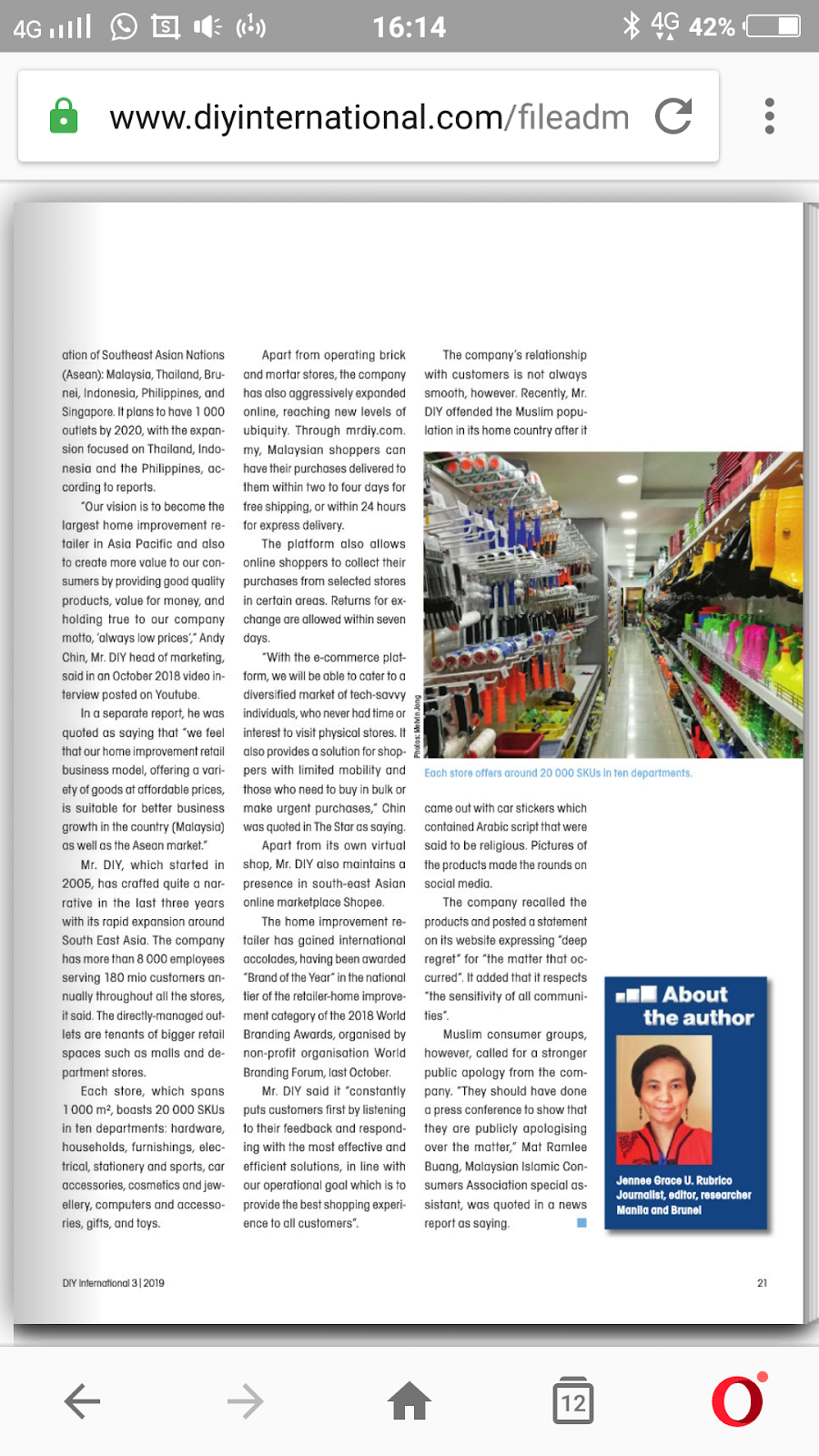
This came out in the Southeast Asia edition of DIY International. Good Home is one of the fastest-growing home improvement chains in Brunei that is trying to change the mindset of shoppers towards a truly DIY market. Published July 2019
I wrote this article on Malaysia's Mr. DIY's regional expansion and planned flotation. Article came out in the Southeast Asian edition of the quarterly home improvement trade publication. Publication date was July 2019.
MASCOTS and a crowd marked the opening of Jollibee’s 17th branch in Brunei at OneCity, a new shopping center, last January. — MELVIN JONG/ PIX
By Jennee Grace U. Rubrico
BANDAR SERI BEGAWAN — In one of the most densely populated residential areas of Brunei, a Jollibee drive-through outlet is being built that is poised to cement the red-and-yellow bee’s position on the top of the sultanate’s food service industry heap.
Standing next to a gasoline station and just across the road from the newest McDonald’s branch in the country, the soon-to-open outlet in Lambak — population, approximately 30,000 — will be Jollibee’s 18th.
Jollibee holds the distinction of being the biggest food franchise in the sultanate in terms of store count alongside US fastfood rival KFC. The Filipino brand, which is managed by Entrek (B) Sdn Bhd, and KFC currently have 17 outlets each in Brunei.
Not to be outdone, KFC is also building an 18th outlet in a different location, and the race for having the most restaurants in the sultanate continues.
Pizza Hut, on its part, has 15 outlets, McDonald’s has three, while Burger King lists seven.
Quick service restaurant Ayamku, Brunei’s answer to Jollibee and the most popular locally owned fastfood chain, has 14 stores around the country.
Jollibee’s 1987 foray into the Southeast Asian petrostate — population, 421,000 — marked the beginning of the brand’s international expansion.
More than three decades on, Jollibee’s operations in the country are supported not only by the 20,000-strong Filipinos who live here but also by locals who know it as the “home of the famous Chickenjoy.”
“[It’s] good food at a good price. You can get a piece of chicken, rice and a drink, which to me is a full meal, for just under B$4 ($2.98),” said Redzwan Kamarudin, a local who said he drops by Jollibee for takeout twice or thrice a week, or whenever he feels “lazy to think of what to have for lunch and dinner.”
He also said having a Jollibee branch that is always within reach, as well as the perception that Jollibee food is not as unhealthy as the offerings of other quick service restaurants, adds to the brand’s popularity.
“Compared to the rest, they’re kind of a relatively healthier option” because of the rice meals, he said.
Jollibee’s bestsellers in the sultanate are the trademarked Chickenjoy fried chicken, which comes in the regular and spicy variants, Jolly Spaghetti, and the recently introduced Nasi Lemak Chickenjoy, a made-for-Brunei fried chicken-and-rice dish served with sides of hard-boiled egg, anchovies and sambal (a spicy paste).
“We’ve seen the demand for our famous Chickenjoy grow and how people in Brunei are truly enjoying other Jollibee favorites,” the restaurant said in response to questions sent by BusinessWorld via e-mail.
The fastfood chain’s service also draws in the crowds.
“Service is consistently efficient — rarely do I have to wait for more than 10 minutes for my orders,” Mr. Kamarudin noted.
Rudolf Portillo, a Filipino photographer in Brunei who came to the country in 1995 as a Jollibee employee, said that the fastfood chain brought its brand of human resource training to the sultanate when it came over.
“Noong time namin or earlier, majority Pinoy kami at lahat kami talagang galing ng Jollibee Philippines, kaya baon talaga namin ang training. Tapos, established na ang ganoong service ditountil now (During our time, or earlier, majority of us were Pinoys, and we were all from Jollibee Philippines, so we brought with us our training. And then, that kind of service has been established here until now),” he said.
Mr. Portillo said that even then, the fastfood chain was already popular among Bruneians.
Jollibee, on its part, attributes its success in the Muslim country to understanding the market. “We understand that the very core of the Bruneian values is the importance of family. By providing great tasting food like our Chickenjoy at affordable prices served with friendly warmth, we see families come together over Jollibee meals. This has made Jollibee the Number One family fastfood chain in Brunei,” the restaurant said.
It added that it makes sure it meets all the regulatory requirements of Brunei, particularly that of halal certification.
In what some consider an already saturated market and given the economic slump that Brunei has been grappling with over the last four years, many food companies have opted to put expansion on hold, and some have even closed shop. Jollibee, however, has yet to show signs of slowing down in its oldest overseas location.
It was only last January when Jollibee flung open the doors of its 17th branch — located in a newly inaugurated shopping center — to much fanfare. Mascots were brought in, and queue-forming promotions were held. Coupons and discount vouchers were distributed days in advance.
“We will continue to open more stores in Brunei as we see potential for more growth. The locations of our stores are determined by different factors, which are proprietary to us,” Jollibee said.
“Jollibee is all about sharing the joy and through our products, we would like for this to continue here in Brunei.”
This is a promotional video for Unicef Philippines' 70th anniversary. My contribution was providing data on Unicef's activities in the country from 1948 to the present.
A report I submitted to Unicef Philippines as part of my engagement for Unicef @70 made its way to the November 24, 2018 issue of Business Mirror. Click here for the original story.
Earlier this year, I had the privilege of being tapped for a project that entailed researching on and writing about UNICEF's work in the Philippines as part of its UNICEF @70 campaign and celebrations. One of my tasks was to come up with a narrative that provides a snapshot of UNICEF Philippines' work over the last seven decades, with a time line of milestones and highlights.
During the 70th anniversary celebrations of UNICEF Philippines last November 20, the publication containing my research, entitled Seven Decades of Upholding the Rights of Children, was released.
It is gratifying to be part of this significant event in the UN agency's history in the country. It was a pleasure to not only be intimately acquainted with UNICEF's wide-ranging and results-oriented work for the children and women in the Philippines, but also to have been given the chance to meet and speak with the most extraordinary people -- famous or not -- who have dedicated their lives to protecting and upholding the rights of society's most vulnerable members.
Congratulations to UNICEF Philippines for 70 years of working to make the country a better place for children, and to the UNICEF Communications team for staging a campaign that has proven as effective as the services rendered by the agency for the country.
Thank you, UNICEF -- first, for choosing me to be part of a worthwhile project, and second, for turning the narrative into this publication that served as a companion to the 70th anniversary celebrations.